Created by Arthur Brock
“We are entering a post-industrial age where wealth and economics are changing. What does this mean for us?”
I recently read a Balinese folktale Gecko’s Complaint and thought of all the businesses, organizations and individuals working to make the Monadnock Region’s communities more vibrant and healthy. We all, while reaching towards our goals, may unintentionally interfere with one another.
Like the gecko, I have complained about the firefly that keeps me from sleeping. Could it be that just like the firefly, whomever I am complaining about means no harm and is actually helping me reach my goal?
“So the Chief called Gecko in once more. In a stern voice he said, ‘Gecko, no more complaining! We’re all connected in ways we sometimes can’t see.”
We are all connected in ways we can’t see. What are our common goals? How can we self-organize and work more synergistically? Instead of working on our goals in isolation, let us acknowledge our interconnections and create something larger and more beneficial to the whole.
By David Sobel, Antioch New England University, Core Faculty
Foreword to the Monadnock Farm & Garden Education Toolkit
A toolkit? Looks like just a bunch of glossy pictures and words at first. Where are the packets of seeds, the trowel, the fork, the trusty hoe, the watering can? Well yes, you need all those things to actually plant a garden, but what if you are wanting to plant relationships? Relationships between vegetables and children, between gardens and schools, between farms and communities? What kind of tools do you need then? To plant relationships, you need good stories, ways to get in touch with people, reasons to collaborate. You need to know what it is you are going to get out of these new relationships, and how each new relationship will make the world a better place.
Remember how Miss Rumphius planted lupines all over the countryside to make the world a more beautiful place? Well, the Monadnock Farm and Community Connection’s folks, Meg, Bonnie, the Amandas, Jeff, Jen and Jessica, are all about making our corner of the world a healthier place through building relationships between kids, kale, curriculum and communities.
The Monadnock Region would be a better place for learning and living healthy lives if there was a garden at every school, a farm connected to every school lunch program and a farmer’s market every day of the week. If we believe in Vision 2020, the idea that our region’s communities will be the healthiest in the nation by 2020, then creating these relationships that engage all of us in growing and eating locally grown, healthy food is an integral part of that vision.
Each one of the stories in this toolkit can help you start to till the soil in your community. Learn how kindergarteners in Alstead, master gardeners in Keene and farmers in Winchester are all working to make tending and growing and harvesting a regular part of the air we breath every day. Learn how to help children throw off the shackles of their cell phones and savor the crunch of their celery. Learn how to seek out the fresh pressed and the just picked.
Take my hometown of Harrisville, for instance. I can buy locally raised lamb, pork, chicken, beef and yes, even goat from local farmers at The Harrisville General Store. (I admit, I was a bit leery of goat, but we tried it in moussaka and it was great.) We press our own cider from apples on my backyard trees or our neighbor’s wild trees. I can stop at Jody’s to pick up recently laid Silver Lake Farm eggs. Raised beds may be sprouting at the elementary school. The maple sugarer drops off a quart or two of syrup from the trees on my property that he is tapping. And just a few weeks ago, the old field in the triangle between the Harrisville and Nelson roads was tilled to make way for the new community garden next spring. Eleven of the twenty plots have already been claimed. My food is coming home again. Which is the way it should be.
Use this toolkit to plant relationships between your farm and the local school, between the community garden and the community kitchen, between children and good grades. All those relationships will make the Monadnock Region a more beautiful, and a healthier, place.
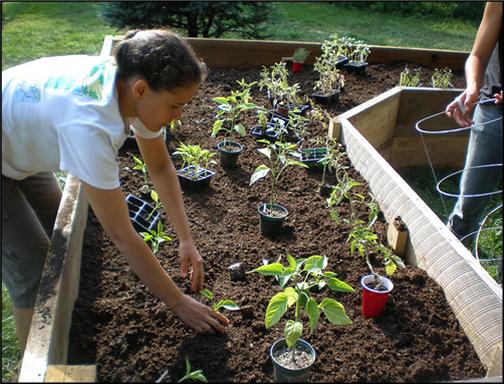
Enjoyable green spaces. This is a topic on the forefront of many minds these days where school gardens are becoming a norm and the concept of edible landscapes is blooming. At Antioch’s campus in Keene, NH, the lawn is now growing food for the on-site café and is one of the most popular outdoor classroom spaces.
Four garden boxes, each two feet high and six feet long, create corners for an open space where people can sit and socialize, classes can meet, musicians can play, and inspiration can be derived. In its first summer a variety of vegetables and herbs filled each bed, including peppers, tomatoes, basil, Swiss chard, pole beans, sweet peas, carrots, and much more! This fall as leaves started to drop, produce was harvested, garlic was planted, and plans for winterization began materializing. Throughout its first season students across departments combined efforts to create educational and funding sources, and the Antioch community as a whole is a buzz with excitement about the possibilities.
Project Beginnings
Antioch University New England is a unique location for a school garden. It is a graduate school that caters to a wide range of disciplines including clinical psychology, integrated learning, environmental studies and more. ANE values ecological stewardship and place-based learning experiences, and the creation of an on-site vegetable garden is an example of these values.
In March of 2009, a number of Antioch students, faculty and staff attended the workshop “Grow Food Everywhere” hosted by Deb Habib of Seeds of Solidarity. Discussions following this workshop revolved around the desire to have a working, edible landscape on Antioch’s campus. A few months later, the Antioch Garden Committee formed, a garden proposal was submitted to the campus president, and plans for construction were approved.

An Antioch student took the project on for her summer practicum and with loads of support hit the ground running. By July 2009, four garden boxes were built and a variety of vegetables planted. In the words of one volunteer, “Something beautiful has begun.”
Supplies for building the boxes were made available by local farms, students, faculty, staff and alumni. Over $500 was collected through in-kind donations and a gift from the graduating class of the Environmental Studies department. This provided the capital needed to buy the lumber and a few maintenance supplies.
Over 155 volunteer hours were committed to making this project a reality. Currently there are two paid work study positions that coordinate the garden efforts and are supervised by a faculty member. The garden is now able to use compost that is produced on-site from collected food waste and a center garden bed was created, which will host a garden of medicinal plants starting in the spring of 2010.
Up and Running
The theme of Antioch’s garden is truly “many hands make light work.” Two garden coordinators host ‘work parties’ where everyone is welcome to come and participate in garden related events such as: planting garlic, harvesting produce, turning the compost pile, putting the beds to sleep for the winter, or participating in fundraising events. The work parties have been an opportunity for new folks to meet each other, a great time to socialize after a day of classes, and an opportunity to take part in producing the food that is eaten on campus.
The first garden fund raiser, a sustainability themed book fair, to raise funds for the purchase of materials for spring planting and project expansion was a campus-wide success.
Two different cold frames were built and more greens have been planted to extend the growing season and provide an educational experience for overwintering with small, box gardens. Students collaborate with the facilities staff as well as the landscaping crew to enhance the communication between different parties dedicated to preserving and maintaining the beauty and integrity of Antioch’s campus. The gardens are five months old now, and already students are incorporating the gardens into class curriculum and master’s projects – the medicinal garden being the first master’s project.
Hurdles to Overcome
There is concern that there may be gaps in leadership for the maintenance of the gardens from season to season or year to year because this is a student led initiative aligned with the school calendar and not the growing season. Staffing the work study positions throughout the summer, the attraction of animals or rodents and the loss of open, green space have also elicited some concern from the Antioch community. There is also a lack of continuous funding for project expansion.
Evaluation tools are being developed to help track this information. Small grants have been considered and more research is being done as to what is available, but there are few grants that cater to smaller scale, vegetable gardens at higher level institutions. The location of the campus has also raised concerns about the soil quality for the gardens. Soil tests were sent to UNH prior to planting, and the results did not indicate any threats to the health of the soil. If the program hopes to expand to other areas of the campus, soil quality will need to be considered in those locations.
Planning for the Future
Students continue to express interest in using the gardens or garden space for class projects, faculty are considering how the gardens can be used as an experiential learning tool, and the committee hopes to expand the growth of food both for the purposes of the on-site café, as well as the local community kitchen. Plans are being made to utilize the garden for classes such as Soil Ecology and Place-based Learning. Entomology, a class held in the summer that studies

the eight major orders of insects, could utilize the garden for observations. Two students are currently planning a “Quest” that would have students finding items or investigating aspects of the garden and compost piles.
There are other students researching ideas for how new classes could be offered at Antioch including Eco-Therapy and Sustainable Agriculture. These visions for the future of the garden space are just at the tip of the iceberg. Student groups are beginning to brainstorm ideas for continuing to make our campus a “green” working landscape—and the expansion of the garden space on campus is a top priority. Beautiful things truly are happening on ANE’s campus.
Advice for Other Schools/Projects

 Yarden of Eatin'