News

Local Living Economy Building Block: Sustainable Agriculture & Our Local Food System

Jen Risley's avatarMonadnock Buy Local

Which businesses, organizations and initiatives are supporting sustainable agriculture and the local food system in our Monadnock Local Living Economy?

In 2012, Facebook fans generated a short list of recommendations – we hope you will add your suggestions/updates as well:

  • Manning Hill Farm: From Angela: “The best milk ever!”
  • Orchard Hill: Via Stephanie “I will put a word in for my friends over at Orchard Hill in East Alstead again, specifically responding to the local food system question this week, the Village Roots CSA and Orchard Hill Breadworks. Ellen doesn’t have a website for the CSA, but I found this blog post from 2010 that has the link to the Breadworks site, and talks about how the gardens are so connected to the Orchard School curriculum.”
  • Tracie’s Community Farm: From Ann: “Her farm is wonderful, and she is such a dear, sweet soul. Loving for the CSA!!!”
  • Walpole…

View original post 62 more words

Monadnock Region CSA Fair

Event-Slider-2015-CSA-Fair

Help spread the word on Facebook

A free Monadnock Region CSA (Community Supported Agriculture) Fair will be held at the Monadnock Food Co-op’s cafe on Sunday, February 15th, 1-4 p.m. Six area CSA farmers will have informational tables and be on hand to answer questions on their farms and CSA memberships:

Foggy Hill Farm is a family-run organic farm located in Jaffrey. With over 20 years of farming experience, Andy and Christine have a deep-rooted passion for raising high-quality, nutrient-dense foods in a manner which helps unite our community: 603-593-5325, foggyhillfarmer@gmail.com.

Hillside Springs Farm and CSA Garden, a hand and horse powered farm in Westmoreland, offers vegetables, herbs, apple cider, pick-your-own flowers. 603-399-7288.   www.hillsidespringsfarm.com, hillsidespringsfarm@gmail.com

Picadilly Farm in Winchester offers vegetables, fruits, herbs, and flowers through full season, summer season and winter shares. 603-239-8718.  www.picadillyfarm.com

1780 Farm in Chesterfield offers vegetables, berries, eggs, and meat. 603-363-4476, www.the1780farm.com

Sun Moon Farm in Rindge provides vegetables, herbs and cut flowers to our members. Located at “The Meeting School,” a property that has been continuously farmed since 1783, the farm grows over 75 varieties of old and rare Dahlias and offers members artisan breads that are baked here on the property,  sun.moon.craig@gmail.com.

Tracie’s Community Farm in Fitzwilliam, offers Spring, Summer and Fall Shares including a wide variety of vegetables with a home delivery option, as well as options to add herbs, flowers, fruit, bread, eggs, and more. 603568-6102, farmers@traciesfarm.com, www.traciesfarm.com

Although each local CSA farm is unique and individually run, each offers “shares” of locally grown food to community members. There are variations in the price, share size, distribution, choices, pick-up sites, payment plans and variety of food offered. Some CSA farms concentrate on vegetable production, while others offer eggs, meat, flowers, berries, maple syrup, honey, raw milk, cheese, yogurt, or other local products.

The commitment from community members to join a CSA implies a willingness to share with the farmer both the rewards and risks of small-scale farming. Weather, pest damage, and crop failures affect both the farmer and the shareholder. The entire community absorbs the costs of raising food in sustainable ways, and farmers receive consistent appreciation and financial support for their efforts. The shareholders know when, where, and how their food is grown, and are assured of high-quality and nutritious produce, grown without the use of any synthetic fertilizers, pesticides, and herbicides.

A CSA membership supports local farms and the local economy, eliminating the environmental and food quality costs of marketing, packaging, and shipping food long distances. Freshly picked, locally grown fruits and vegetables are a good value because they have superior flavor and more vitamins and minerals than many large-scale commercially raised crops. Sustainable farm practices also avoid the hidden costs of pesticide residues, soil erosion, and polluted surface ground water often associated with large scale conventional agriculture.

Local farmland in CSA use becomes healthier through crop rotation, composting, cover crops, natural fertilizers, and periodic resting. In addition, small farms are able to grow heirloom or little-known varieties of fruits and vegetables, which helps maintain the diversity and vitality of the world’s seed bank. Some CSA farmers chose to receive organic certification for their produce, other farmers use organic and /or biodynamic techniques exclusively but do not choose certification.

MFCC Spring Summit: 2nd Year Review

The Monadnock Farm & Community Coalition (MFCC) Spring 2015 Summit is an opportunity for coalition members to revisit the Strategic Plan and review system-wide progress. Time will allow for members to report on activities, share successes, announce upcoming events, and express present needs with other member organizations and the community-at-large. Our goal is to provide the constituency time to network, engage in each others work, promote and cross-pollinate information and identify collaborations and gaps.

Additionally, MFCC’s sub-committees – the Education and Policy Working Groups – will report on past year’s activities and share work plans for 2015.

The Future of New Hampshire’s Food System needs YOU!

Jen Risley's avatarMonadnock Buy Local

The Future of New Hampshire’s Food System needs YOU

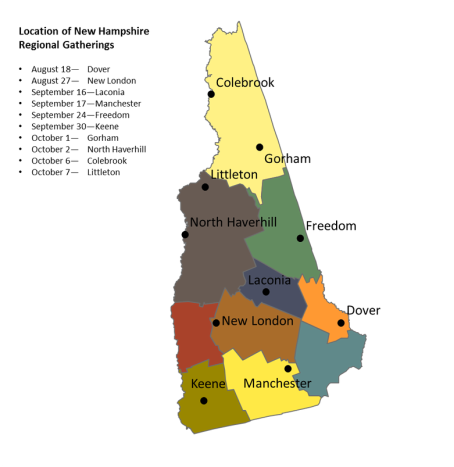
If you spend your professional or civic life focused on food or the food system, please attend a regional gathering to connect with others
and shape our network and strategy. All are welcome.

Attend a regional gathering in your area to

  • have the opportunity to shape a state-wide Food Strategy to better our food system
  • learn about trends, data, challenges, and innovations in our food system
  • network with others doing work in the food system
  • and identify some actions for reaching our food system goals


Picture


View original post