“In nature pollinators like bees, butterflies, or bats carry pollen from plant to plant, and they instinctively know that the intermixing of these pollens nourishes the entire ecosystem. Pollinator businesses similarly carry the best elements of one local business to another, thereby fertilizing all local businesses and creating a healthy entrepreneurial ecosystem.”
~ Michael Shuman, The Local Economy Solution
This spring, Monadnock Buy Local is excited to offer a unique opportunity for our region — one that we hope creates much “buzz” and boosts our collective efforts to grow our local economy. Michael Shuman, author and a leading expert on community economics, will visit our region on April 7 – 8 to share the latest buzz in local economy work — pollinator enterprises. He will provide inspiration for developing, launching and amplifying the work of new and existing pollinator enterprises here in the Monadnock Region and beyond.

Pollinator Enterprises are innovative, self-financing businesses and nonprofits that drive job growth and community prosperity by supporting economic planning, entrepreneurship, local purchasing, workforce development, collaboration and local investing. They are diverse in nature and include youth entrepreneurship schools, local debit cards, makerspaces and local farm delivery services.
The success of these businesses is not solely tied to their financial bottom line, but is connected to community goals like the percentage of jobs in locally owned businesses, number of citizens prepared to start a new business, survival rate of local businesses and other social and environmental measures.
Shuman’s book “The Local Economy Solution” digs deeper into 28 models of Pollinator Enterprises. Here are just a few examples to pique your interest:
Fundación Paraguaya runs agriculture education schools in Paraguay financed through the revenues generated by student-run enterprises. Their theory is to “learn by doing, selling and earning.”
Fledge is a business accelerator in Seattle that offers training and mentorship for startup mission-based businesses. It actually pays the startup to participate in its program, set up as an investment in the company. Fledge then earns equity from the startups that graduate from its program and launch into successful socially responsible businesses.
Tucson Originals is an alliance of locally owned restaurants in Southern Arizona that buys supplies in bulk and markets the benefits of dining locally. More importantly, they work to preserve the heart and soul of their regional culinary culture.
Credibles, based in San Francisco, is an online platform where customers can pre-pay for food from their favorite restaurant, coffee shop or grocery store, and that business receives critical capital needed to grow their business.
Main Street Genome, based in Washington, DC, looks closely at a business’ operations to identify inefficiencies. The savings gained from fixing those weaknesses are split between Main Street Genome and each business it works with.
What about Pollinator Enterprises that already exist in our region? There are many businesses and nonprofits with Pollinator Enterprise-like qualities. We hope to see more of them become self-financing in the future.
They include the Hannah Grimes Center for Entrepreneurship’s Incubator Program, Monadnock Buy Local’s emerging Debit/Loyalty Card Program, Monadnock Table Magazine, Monadnock Art x Tech Markerspace, Make It So Makerspace, Monadnock Menus, New England Web & Tech Collective, Regional Center for Advanced Manufacturing, YEA! Young Entrepreneurs Academy, Arts Alive!, Team Jaffrey, Keene Downtown Group and many more yet to be identified. Help us add to this list by contacting monadnockbuylocal@gmail.com. Stay tuned for more Monadnock Region Pollinator Enterprises at monadnocklocal.org/monadnockpollinators.
We invite you to learn more about Pollinator Enterprises at Michael Shuman’s free public talk on April 7th at 7 p.m. at the Keene State College Alumni Center. This event is part of the Greater Keene Chamber of Commerce’s Regional Issues Series and is sponsored by the Hannah Grimes Center for Entrepreneurship, Healthy Monadnock, Keene Yoga Center and W.S. Badger Company. Michael will also lead a more in-depth daylong workshop on April 8th at the Hannah Grimes Center for Entrepreneurship. Learn more at monadnocklocal.org/pollinators.
Our region has a strong vision for a sustainable community and solid economic development plans to get us there. Let’s expand our capacity to implement this work! Pollinator enterprises illuminate a path forward for us — towards our collective vision. Please explore this new model of community economic development with us, and discover how we can help our local economy flourish.
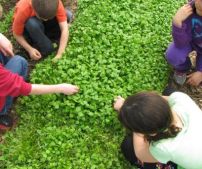 Farmer John’s Plot will manage a farm laboratory across the road from ConVal High School where students from that school and others will engage in hands-on sustainable farming courses and experiences. They are joining forces on this farm site with the Cornucopia Project, a local non-profit that focuses on tying gardening to primary education. Their programs will combine to provide a seamless path from elementary garden education all the way up through high school and post graduate sustainable agricultural training via our incubator program.
 It’s time to start planning this year’s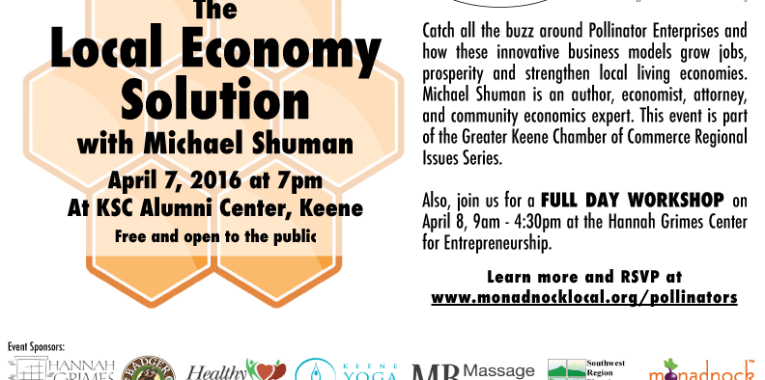

 Yarden of Eatin'