Symonds School: Transforming Green Space into Diverse Habitats

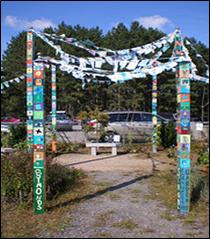
Artist in residence worked with students to create this garden art.

Case Study 8

The Symonds School, located just off of Park Avenue in Keene, NH, exemplifies the culmination of dedicated parents, faculty, staff, and students working to beautify the landscape and provide hands-on educational opportunities for all.  A variety of garden beds surround the school grounds, located near entrances, fence lines and within the playground space.  Among these garden plots, diverse annuals and perennials, large sections of sunflowers, and vegetables are scattered throughout.

In addition to the plants growing in these gardens, there is beautiful artwork that creates a sense of belonging, both to the community members that invest time in maintaining the gardens, and to the folks that simply enjoy the area.  There are small huts built out of sticks with plants growing all around them where children play during recess, beautifully painted poles with wish flags flying in the wind, a hand-built patio, and shrubs with various bird species fluttering in and out of the branches.

These garden spaces not only provide great aesthetics to the school grounds; the benefits of this program unfurl for each student, every classroom, and then continue to extend to families, businesses and organizations throughout Cheshire County.

Project Beginnings
Four years ago, the playground area at Symonds Elementary consisted of dust, sand, and pavement.  Parents, faculty, and staff came together and decided that this area needed to be more useful, more  biologically diverse, and more conducive to learning.

Goals were established, grants were written, and the program began to take shape.  A garden committee was formed and art was integrated into the program. Year after year, more and more garden plots sprouted around the school building.

Up and Running

Individuals, families, or classes can ‘adopt’ a portion of the garden and do whatever they would like with it, while following organic growing principles and using native species whenever possible. Two master gardeners that work at Symonds help with some of the planting, advising, and maintenance of the garden beds.  An inspiring aspect of this program is that people not only maintain their garden spaces but purchase new items and really work to make these gardens dynamic.  The program has been funded by a Fish and Game grant, along with donations and fundraisers. The PTA played a crucial role in helping get this program off the ground.

Along with the donation of funds, local businesses have contributed materials such as hoses, tools and compost.  This program is zero cost to the district, which allows for a bit more flexibility.

“Our program is unique in that it is very community oriented and it feels like common space for people versus owned and regulated. There have not been issues with vandalism and it is not just science based,” said Susan Meehan, teacher at Symonds School.

Planning for the Future

The Garden Committee has combined with the Playground Committee to revise and develop goals including:
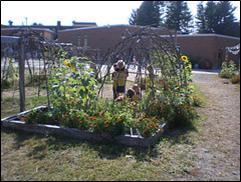
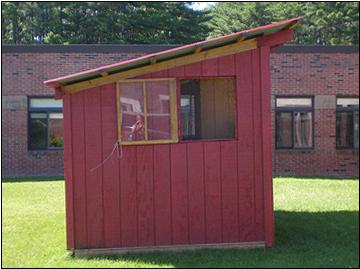
Artist designed structures that act as beautiful places to play at recess. They are a big hit!
  • grow more food in conjunction with the seasons
  • develop a summer program that can help maintain the gardens
  • coordinate with wellness education
  • create more spaces for children and animals throughout the playground

Advice for Other Schools/Projects

Folks involved with the Symonds school gardens advise other start-up groups to:

  • Look into garden clubs for plant donations and seek advice from master gardeners or your local extension service
  • Involve your PTA!
  • Community awareness about available garden space will help with maintenance and making the space available to more people.
  • Have a clean up and planting day to get people engaged and excited about your project.
  • The Fish and Game grant was a big help to the Symonds School, and having a focus other than just growing food has provided a lot of opportunities for classes, students, and families.

Stonewall Farm: Building Bridges

Case Study 7

Using bee puppets, children pretend to pollinate squash flowers in the garden.

Stonewall Farm in Keene, NH, is a nonprofit working farm and education center dedicated to connecting people to the land and to the role of local agriculture in their lives. Set in a scenic valley, Stonewall Farm consists of pastures, fields and woodlands.  As you walk around the farm, a geodesic dome greenhouse and two acres of gardens pop out of the landscape and invite you to take a closer look.

Amanda Hopkins serves as the garden manager  at Stonewall Farm, and acts as a bridge between the gardens and the Farm’s education programs.  Every year, Amanda works with Keene High School students, community volunteers, and children who come to the farm for summer camp and school programming. She dreams of working with more local schools starting in the spring of 2010.  This winter, she is working to create curriculum to bring the garden deeper into their educational programming and to nearby schools.  Amanda is “inspired by the garden and the proximity to Keene area schools who can use us as a resource…for all the schools who don’t have the opportunity to have a school garden and for those that do.”

Project Beginnings

Amanda started working at Stonewall Farm two years ago with the goal of expanding the existing Farm to Table program that already draws many school groups to Stonewall Farm.  Amanda’s goal is to create outreach partnerships to help schools with curriculum and linking farm and garden activities to state and district standards.  Part of this work involves meeting with teachers to identify their needs, gauging the age and ability of the students involved, figuring out their classroom and school grounds resources, and then determining how to incorporate the teachers’ interests, skills, and energy.

As more and more teachers and districts embrace place- and agricultural-based curriculums, it’s critical that there be resources available to help add fuel to their fire.  Amanda notes: “their days are already packed as it is, and I want to help.”

Up and Running

The knowledge and skills that will help to turn Amanda’s vision into reality came from myriad life experiences: a Master’s Degree in Environmental Education from Antioch University New England, an internship with Tracie Smith of Tracie’s Community Farm, working at the Youth Horticulture Project of Brattleboro, being a NOFA member and attending conferences, going to Small and Beginning Farms workshops, involvement with the Keene Farmers’ Market, and visiting a variety of farms and farmers.

To start up the garden program, funds will come from the garden’s produce sales at the on-site farmstand, Keene Farmers’ Market, and her new year-round CSA.  Once running, the garden programs will generate its own revenue.

A great support network at Stonewall Farm also makes the garden program possible, including Amanda’s new production and floral coordinator, Sarah Barkhouse.  Sarah will relieve Amanda from the coordination and oversight of daily garden tasks and allow her to focus on the development and execution of educational programming.  A pilot program with a second grade class in Marlborough this spring (2010) will provide the foundation from which the program can grow.

Another great opportunity for curriculum development has been the evolution of the C3, Cultivating Community Connections, Partnership with Keene High School’s (KHS) Career Center.  The original C3 program, funded by a SARE grant two seasons ago, was a partnership with the Horticulture, Culinary and Marketing departments at KHS. The program has since reduced its scope to working mostly with the Horticulture classes in planting and harvesting field crops, and less with the Culinary students’ on-site café.

Hurdles to Overcome

While the garden outreach program has great support from the staff at Stonewall Farm, there are still hurdles to overcome.  Dealing with the challenges of managing limited time, working under the constraints of the school day schedule, tight school budgets, and school transportation for groups are all issues to address.  Another barrier is the lack of access to information needed to move forward with some of the school programs.  Though Amanda is bridging the garden and education programs, she sees the need to strengthen this connection in the future.

“I would like students to understand that gardens produce food. Real, tangible, edible food and that you need to work hard in order to harvest the benefits from that garden, and when you do, not only is there a lot to learn from but, boy does it taste good too!”

Planning for the Future

The future has much in store for Amanda and her visions.  This winter, curriculum development and gaining teacher support are the first steps.  Along the way,  Amanda also recognizes the need to identify existing garden-based curricula and figure out how they match local curriculum in schools in order to fill gaps and eliminate repetition of resources.

Advice for Other Schools/Projects

For others who are interested in starting similar food and agriculture programming, Amanda Hopkins advises working on a farm or in a garden to gain experience and knowledge of what works and what doesn’t.  Perhaps you will experience some failures, but you will also learn to problem solve in the process.

Amanda also urges tapping into the resources right at your fingertips:

  • Go to the Keene Farmers’ Market and meet your local farmers and producers.
  • Stonewall Farm offers many education programs, farm tours, and workshops.
  • Many seed companies will donate seeds and catalogs.  Some examples of seed companies to contact are: Fedco, Johnny’s, Seeds of Change, and Seed Savers.
  • Cooperative Extension and 4-H offer lots of support.
  • Experienced farmers in the area can be great resources (as long as you approach them in the winter.)
Summer camp celebrates a good morning of weeding.

South Meadow School: The Dream Becomes Reality

Inside the Greenhouse at South Meadow School.

Case Study 6

“For some kids, coming to school is easy.  For others, school is a struggle. We want to have something that can reach them,” says South Meadow School Principal Dick Dunning. For one student at South Meadow Middle School in Peterborough, NH, coming to school was the last thing he wanted to do. But the day he got his own chicken, he said “This is the best day of my life!”

When Dick Dunning first arrived at South Meadow School, he already had a vision for how they could better use the school grounds as an educational space. From the very start he wanted to build a greenhouse on the school’s front lawn. His dream became reality in 2003, and in the following years the program blossomed into so much more.

In addition to the greenhouse, a multitude of other food and agriculture opportunities are now available on the school grounds of South Meadow Middle School. These include: vegetable gardens, a koi fish pond, bee hives, a chicken coop, an industrial composter, and herb gardens. All of these structures and programming are incorporated into not only the curriculum but also into the broader community. School administrators, teachers, and staff are constantly looking for new and different ways to utilize the infrastructure they have created to enhance food and farming both within the school and throughout the community.

Project Beginnings

A trellis for peas stands near South Meadow  School’s Greenhouse.From the very beginning, the goal of the food program at South Meadow School was to provide engaging hands-on learning opportunities for students. Dick’s desire to make this happen through food and agriculture came from his own background with 4-H, Boy Scouts, and other school outdoor/natural experiences he had growing up.

To buy the materials to build the greenhouse, the school raised $58,000 through in-kind donations and grant money from foundations and trusts. Dick Dunning and Bruce Dechert, Assistant Principal at the time, assembled the greenhouse themselves—a move that saved the school a total of $26,000.

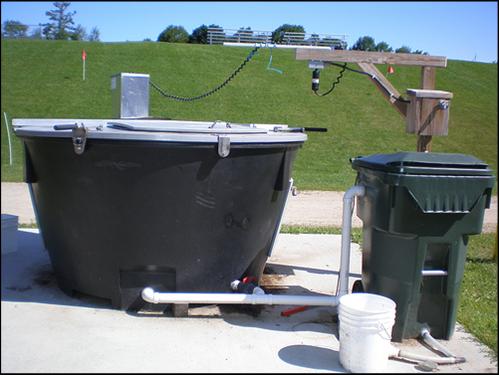
After the greenhouse came outdoor garden beds, followed by bee hives in 2004, and both an industrial size “Earth Tub” composter and a chicken coop in 2007. Apart from the greenhouse, the “Earth Tub” was one of the greatest expenses thus far ($10,000) and these funds came from a grant through the Walker Fund of the New Hampshire Charitable Foundation.

Up and Running

During the summer months when school is out of session, South Meadow School partners with the Cornucopia Project’s summer camps to help maintain and enhance the school’s outdoor garden beds. The Friendly Farm in Dublin, also partners with the school  by providing a summer home for the school’s chickens.

The EarthTub composter is where all food scraps from South Meadow School end up.

One of the daily tasks that students are a part of at school is to take classroom food waste and scraps out to the “Earth Tub” composter. Food service staff also contribute food waste from the cafeteria to this giant compost system that can hold hundreds of pounds of food material to create compost that is added to the gardens.

Teachers use the onsite facilities for various lessons and class projects throughout the year. Food and agriculture is also intentionally incorporated into classroom curriculum throughout a student’s time at South Meadow School, staring in 5th grade when students complete a biosphere activity.

To raise funds for the school’s new infrastructure, Dick Dunning thinks outside the box and uses the schools existing resources in new ways. One of his most successful fundraising events has been to invite the community to the school’s gymnasium for an evening of roller-skating.

Hurdles to Overcome

While South Meadow School was fortunate enough to have administrative support from the very beginning, there were still a number of challenges that had to be addressed to get the program where it is today.  Dick points out that building codes and other legalities must be dealt with before moving forward. Also, while South Meadow was fortunate enough to already have the support of their principal, Dick found that at times there was a lack of vision or initiative among staff.

Planning for the Future

The South Meadow School chicken coop isn’t far from the indoor classrooms where students also spend time learning.

Dick Dunning is still dreaming about ways that the program can expand in the future. Some day, he envisions having an entire farm on-site at the school, with a barn and small animals where students can learn about and more deeply connect with food and agriculture. He also hopes that someday the school will be able to sell the koi they raise to local residents.

Beyond looking at improvements that they can make to the school facilities and programs, Dick is also interested in reaching out and making a deeper connection to the community. He wonders, “What other community needs can [South Meadow School] fill?”

Advice for Others

For other schools that are interested in starting similar food and agriculture programming, Dick Dunning offers the following advice:

  • Get administrative support before you begin.
  • Network and partner with local organizations and resources.
  • Involve students—they are the bottom line!
  • Don’t be afraid to take risks.
  • Get commitment from teachers. Identify their needs and help them meet their needs through the program.
  • Try to fill a niche within the community.

The Orchard School: A School Growing Food and Community

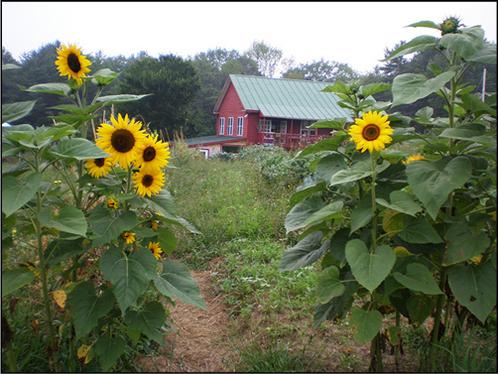
Sunflowers give way to the view of the Orchard School from the CSA Garden.

Case Study 5

The Orchard School sits on a hill that faces the local bakery, Orchard Hill Breadworks and abuts the Orchard Hill Community.   A playground with raised bed gardens is connected to rows of beautiful, green vegetables that are sold through the Orchard Hill Village Roots CSA.

During the school year, young students wander through these beds asking questions to the attending gardeners.  There is a pond just over the hill where campers can take a dip on a hot summer day after learning about growing, harvesting and cooking a fresh, garden meal. The opportunities for learning at Orchard Hill are abundant, the scenery is beautiful, and the various on-site businesses resonate with the vision to provide holistic education for all ages.  This is what makes the Orchard School Community, with its roots firmly planted in farming and food cultivation, unique and worth experiencing.

Project Beginnings

In 1990, The Orchard School and Community Center was founded by three friends, Eleanor Elbers, Kathy Torrey, and Kathleen Vetter, who shared a vision for a community place of gathering, growing and learning. They joined resources and for three years held preschool classes in a teacher’s home. The demand for childcare made it clear that the community needed the school, and the school needed a home for its increasing numbers of students.

The Elbers Farm in Alstead became the chosen site as it had been the nexus of a farm/village community since 1971.Over the course of that year, the school’s leadership and responsibility were shared by a core group of parents, community members, teachers and their spouses. This spirit of goodwill and cooperation formed the most important foundation for the school.

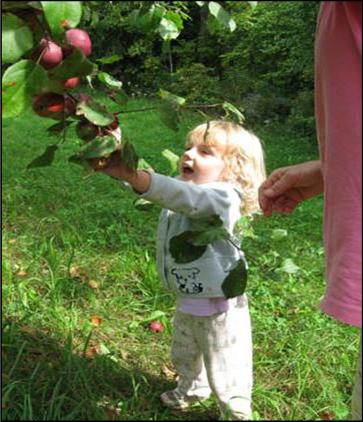
Children harvested peaches for a week straight using their favorite sandbox dump trucks. Good thinking!

Marty Castriotta, Facilities Director at Orchard Hill, explains his sentiments,  “We have strong intentions and values and we try to instill a sense of place and appreciation of agriculture.  The school was built in 1994 and has had gardening integrated into the school in some capacity since the beginning—it was an organic connection since the school is located on a multi-generational farm.””

As Facility Director, Marty maintains the buildings and grounds with an eye towards energy efficiency and health. He is also the environmental educator, leading after-school programs and farm-based fieldtrips.  During the summer, he is also the Counselor Coordinator for Orchard Hill’s farm and forest camps.

Up and Running

The focus of the Orchard School goes beyond outdoor education to create a village culture.  The mission is to be an accessible place of learning that nurtures:

  • a sense of community
  • respect for individual differences
  • the land
  • lifelong learning
  • a connection between the cultural life of our rural community and that of the world beyond.

Teachers embrace each student and share with them a sense of connectedness with the surrounding physical and cultural environment.  Although they are a private school they see themselves integrating into the larger community through communication, sharing, and trading resources.

The Orchard School Preschool and Kindergarten classes use the Community land (farm, orchard, bakery) and raised beds outside the school house for learning opportunities year round.  The variety of spaces teachers are able to utilize provide for many organic learning opportunities.  Marty  Castriotta explained that often he will be working in the garden and kids will spontaneously come up and ask questions.  These interactions are at the heart of the Orchard School.

Beyond this they also make use of curriculum such as Digging Deeper, Stella Nutura-Biodynamic Farm Calendar, Project WET, and Project WILD. They often draw upon the concept that a farm is a living organism and observe how every element within the farm is connected.  Storytelling is an important technique used such as selections from “The Mountain Stands Alone.”

Summer day camps enliven The Orchard School from late June until the middle of August.  One week in the summer is designated “Farm Camp”  where children directly participate in the happenings of the farm.  They take part in more of the farm activities and play games that build understanding.

Orchard School’s after-school program, Farmers and Foragers, provides a nurturing home away from home for children ages 10-15 and focuses on local foods. Students visit other farms and stores to learn about the diversity of our food system.   Activities include maple syrup gathering, beekeeping, building portable pig pens, cider making, building a composting toilet, and other activities.

The Orchard School also serves the surrounding community by welcoming other schools to their site for field trips and serves as a Community Center through the workshops and classes offered there to adults. Planning for the school started in earnest in February 1994 with a volunteer effort to erect a 2,500 square-foot building. The following summer, over 275 people from near and far contributed more than 3,000 volunteer hours, and by September The Orchard School opened its doors.

Hurdles to Overcome

The success of The Orchard School is a great model for other school communities looking to innovate and integrate.  Of course, with success comes challenge and the Orchard School still faces some hurdles ahead.

Hurdles for the School:

  • Funding:  The annual fund drive is essential with  parents of students and campers, employees, neighbors, and other community members donating money every year.  Grant awards are another piece of the funding equation.
  • Visioning:  Keeping track of the school’s intention as it grows and develops new programs and staff.
  • Networking: They would like to better understand which schools in the area would like a garden, farm curriculum for the classroom, or come for a farm visit.

Hurdles for the Farm:

  • Regulations: The orchard once sold apple cider until it became illegal with NH’s pasteurization law.
  • Raising capital: More money is needed to grow more food.


Plans for the Future

There are many ideas yet to be developed:

  • Marty Castriotta is working with Stacy Oshkello of Cold Pond Community Land Trust (see Toolkit pages) to develop a  school based program based on nutrition education and food preparation.
  • Promote field trip opportunities for all ages.
  • Develop a stronger after school program.  They are currently working with the Latch-Key Program of Alstead to provide opportunities from 2-5:30pm for kids up to 11 years of age.

Advice for Other Schools/Projects

For other school interested in starting similar food and agriculture programming, Marty offers the following advice:

  • Get a sense of the place where you are – connect to stories of the local people and land.
  • Make connections with local farms.
  • BE ADAPTABLE- educate people about the way things change day to day, season to season, and year to year.
  • Work collaboratively in a non-competitive fashion with other organizations with similar goals.
  • SHARE!