Be sure to visit Monadnock Farm & Community Coalition’s new website and find out how you and your business/organization can get involved!

Be sure to visit Monadnock Farm & Community Coalition’s new website and find out how you and your business/organization can get involved!
 From Monadnock Food Co-op’s Website:
X
Our Discover Local Promotion gives us the opportunity to bite into different parts of our Monadnock Food System, and learn some of the juicy details about each component — from the soil that gives rise to the delectable fruits and vegetables we seek, to the not-so-delectable (but essential) spoiled and discarded food scraps that become compost and are then returned to the soil. This month, we’re zooming in on Farm & Garden Education Programs and their role in strengthening our local food system.
Back in 2009, Monadnock Farm & Community Connection created a toolkit called Feeding the Next Generation that highlighted ten schools and community programs linking young people to local food in our region. These Farm & Garden Education Programs (along with many others) cultivate more local food eaters, better learners, healthier individuals and our future farmers, gardeners and informed citizens.
Here is just a very small piece about just a few Farm & Garden Education Programs in our communities. We encourage you to learn more about the programs in your town and how you can support them. If there’s not yet one near you, use the toolkit to get started!
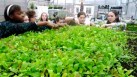 HANCOCK – The Cornucopia Project
The Cornucopia Project serves young people throughout the Monadnock Region and believes kids best understand where their food comes from by growing, harvesting and eating it. “We think that it’s important that kids eat their vegetables… and grow them, too!” Kin Schilling, Founder and Director of The Cornucopia Project explained.
 ALSTEAD – The Orchard School
Marty Castriotta, Facilities Director and Educator at Orchard Hill, shared, “We have strong intentions and values and we try to instill a sense of place and appreciation of agriculture. The school was built in 1994 and has had gardening integrated into the school in some capacity since the beginning—it was an organic connection since the school is located on a multi-generational farm.”
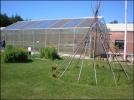 PETERBOROUGH – South Meadow Middle School
In addition to the greenhouse, a multitude of other food and agriculture opportunities are now available on the school grounds of South Meadow Middle School. These include: vegetable gardens, a koi fish pond, bee hives, a chicken coop, an industrial composter, and herb gardens. All of these structures and programming are incorporated into not only the curriculum but also into the broader community. School administrators, teachers, and staff are constantly looking for new and different ways to utilize the infrastructure they have created to enhance food and farming both within the school and throughout the community.
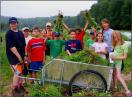 KEENE – Stonewall Farm
Stonewall Farm is a nonprofit working farm and education center dedicated to connecting people to the land and to the role of local agriculture in their lives. Then Garden Manager Amanda Hopkins said, “I would like students to understand that gardens produce food. Real, tangible, edible food and that you need to work hard in order to harvest the benefits from that garden, and when you do, not only is there a lot to learn from but, boy does it taste good too!”
So dive in! Explore and discover ways to nurture these Farm and Garden Education Programs. And as envisioned by David Sobel, Education Faculty at Antioch University New England:
The Monadnock Region would be a better place for learning and living healthy lives if there was a garden at every school, a farm connected to every school lunch program and a farmer’s market every day of the week. If we believe in Vision 2020, the idea that our region’s communities will be the healthiest in the nation by 2020, then creating these relationships that engage all of us in growing and eating locally grown, healthy food is an integral part of that vision.
We wholeheartedly agree!
The Sustainability Project together with Keene State College Campus Ecology hosts the 8th Annual Seed Celebration and Sustainable Community Fair on February 16th, from 9:00 a.m. – 4:00 p.m. at the Keene State College Putnam Science Center. This family-focused event enables all participants to attend skill-building workshops, stock up on organic seeds, learn about local food, environmental and sustainable community initiatives. There will be children’s activities and more than 20 workshops and presentations throughout the day.
Come boost your community’s skills for living well in a changing world. This year’s presentations, so far, include: Planting your First Vegetable Garden, Creating Sustainable Relationships, Beekeeping, Biochar, Home Made Herbal Remedies, Composting, Vermiculture, Mindfulness and Sustainability, Visualizing One’s Way to Right Livelihood, Solar Basics for the Home, Farm, and Business, Organizing a Community Garden, Permaculture: Designing Self-sustaining Systems, Going Out Green: Exploring Sustainable and Meaningful End-of-Life Options, GMO Awareness, Mycological Landscaping, and the Dos and Don’ts of Caring for Your Animal Friends.
At the event, representatives from local non-profits will be on hand sharing their stories and inviting the community to be part of their success. Vendor tables will enable the community to ‘buy local’.
This year, we’re offering the event free of charge in order to ensure that no one will be discouraged from attending due to lack of funds.
Over the years, farmers, gardeners, and activists working for sustainable communities have come to know this event as a great opportunity for networking and day-long fun.

Originally Posted at Vision 2020; By Laura White, James Faulkner Elementary
 At James Faulkner Elementary School in Stoddard, our vision states that we see students “working on real projects.” One way we work to incorporate this into the day-to-day life of the school is through our school garden. A garden provides numerous opportunities for academic integration at all grade levels, whether it is calculating the volume of a raised bed, making change at the dismissal-time farm stand, reading recipes in order to cook our home-grown produce or learning about the prepositions “above” and “below” while studying the parts of the potato plant.
 Yarden of Eatin'